SodaTide: What's in the Capsule, How It's Sold, and What to Know
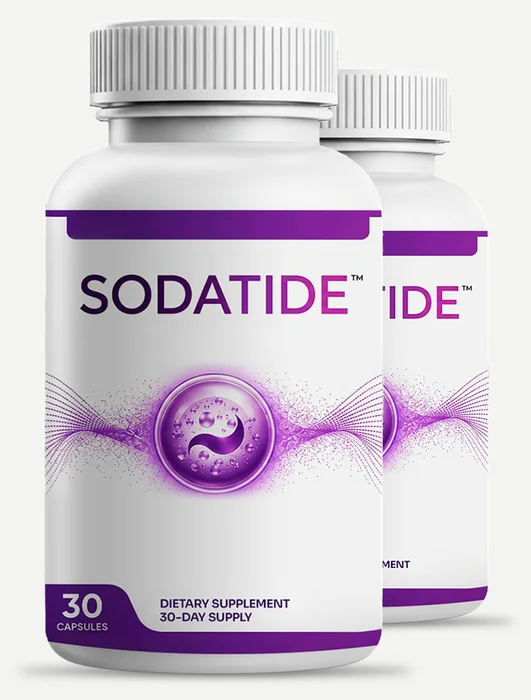
What SodaTide is and how it's sold
SodaTide comes as vegetarian capsules, 30 to a bottle, one a day. The seller calls it a synbiotic: fibers that gut bacteria ferment (prebiotics) packaged with bacteria intended to be alive (probiotics). Despite the name, nothing on the label is baking soda; reporting on its social-media ads describes a kitchen “baking soda” story that ends at a capsule order form.
On November 3, 2026, we loaded ten SodaTide-branded web addresses. The main storefront, mysodatide.com, hands payment to the third-party checkout service BuyGoods. Look-alikes such as ssodatide.com, thesodatide.com and soda-tide.store send buyers to that same order page with affiliate codes attached, so they are promotional sites rather than separate brands; sooodatide.com calls itself the “Official Site” while its footer says it is not affiliated with the manufacturer.
What the label actually says
Per capsule, the Supplement Facts panel on the seller's label artwork lists:
- Chicory root inulin: 211 mg
- Potato resistant starch: 100 mg
- Probiotic blend: 36 mg in total, naming Bifidobacterium infantis, Clostridium butyricum and Akkermansia muciniphila
- Other ingredients: hypromellose (the capsule), microcrystalline cellulose, magnesium stearate, silica
The blend names species but no strains, the codes that tie a probiotic to its research. It gives milligrams but no live count: federal rules require the milligram figure, and a 2018 FDA draft guidance says the agency intends to let makers add colony-forming units (CFU), which it calls a useful description of live microbes. Nor does it split the 36 mg. Blend ingredients must be listed from largest to smallest amount, so Akkermansia, printed last, should be the smallest share, though it is the bacterium the sales pages feature most.
The label also says “Made in the USA with globally sourced ingredients” and tells pregnant or nursing women, anyone under 18 and anyone with a known medical condition to consult a physician first. We don't repeat its front-panel slogans; no trial of this capsule backs them. Storefronts disagree, too: trysodatide.com describes ingredients absent from the label, including Lactobacillus rhamnosus GG and partially hydrolyzed guar gum.
What published research says about the ingredients
No published trial has tested SodaTide itself, so we compare its doses with the studies behind each ingredient.
Chicory inulin. A 2023 review of 50 randomized trials with 2,525 participants found that 3 to 20 grams a day raised Bifidobacterium, gut bacteria generally regarded as beneficial, and improved some bowel-function measures in healthy people; two of its authors work for a chicory-fiber producer. SodaTide's 211 mg is about 7% of the lowest of those doses.
Potato resistant starch. When 20 healthy young adults ate about 24 g of resistant starch a day from raw potato starch, stool butyrate, a fermentation product, rose in some of them and not at all in others. The lowest dose we found tested, 3.5 g a day for four weeks, shifted Bifidobacterium and Akkermansia more than placebo in a 75-person trial sponsored by the ingredient's maker. SodaTide's 100 mg is under 3% of that.
Akkermansia muciniphila. The best-known human trial assigned 40 adults with insulin resistance to about 10 billion cells a day, live or pasteurized, or a placebo for three months; 32 finished. Both forms were well tolerated; blood-marker differences from placebo came mainly with the pasteurized form, the authors called the study exploratory, and several hold related patent applications. Keeping this bacterium alive takes work: a 2022 laboratory study developed a spray-dried milk coating to keep one strain viable through four weeks of refrigerated storage in air. SodaTide's label doesn't say whether its Akkermansia is live or heat-treated, or how many cells a capsule holds.
Bifidobacterium infantis. In an eight-week study of one named strain (35624) in 117 adults, led by a researcher at Procter & Gamble, which sells that strain, stool levels rose during dosing and fell back toward baseline after it stopped.
The word “synbiotic.” A 2020 expert consensus defines it as live microbes plus a substrate that gut microbes selectively use, together conferring a health benefit, with each half of a simple mix expected to qualify on its own; this label gives no way to check either. The NIH adds that probiotics carry more risk for people with severe illness or weakened immune systems.
Facts worth checking before you buy
As seen on November 3, 2026:
- Who sells it. The label lists only “Instituto Experience, Lakeland FL, 33804,” a phone number and an email: no street address, no LLC or Inc. Policy pages sit on a Brazilian (.com.br) domain, the order page is signed “Sodatide Research,” and returns go to an address in Largo, Florida.
- Badges. The main storefront shows a round seal styled as a government sign-off (the order page uses a “registered facility” version), though the FDA says it has no authority to clear supplements before sale. Its “Scientific References” section is a strip of journal and newspaper logos with no article titles, followed by a line saying the company has no affiliation with those organizations.
- Reviews. Storefronts claim 4.7 to 5.0 stars and counts such as 2,400+, 13,000+ or 36,628 reviews. Trustpilot's page for
soda-tide.storeshowed 28 reviews, a TrustScore of 1.5 and 93% one-star ratings; recent reviewers describe refused refunds, a 20% restocking fee and charges for extra bottles. We could not verify individual accounts. - Testimonials. The footer says some names were changed, and the customer photos carry Portuguese file names such as “same people in a different place” plus a date-time stamp.
- Template slips. The main storefront's last order prompt names a different product.
- Ads. The FTC warns that scammers use fake celebrity testimonials with doctored video and audio, and suggests searching a product's name with “scam” or “fake” first.
Prices and the guarantee, as listed
No single bottle was offered:
| Pack | Price shown | Per daily capsule | Crossed-out total |
|---|---|---|---|
| 2 bottles (60 capsules) | $158 + $9.99 shipping | about $2.80 | $358 (order page); $179 (main storefront) |
| 3 bottles (90 capsules) | $207, free US shipping | about $2.30 | $537 |
| 6 bottles (180 capsules) | $294, free US shipping | about $1.63 | $1,074 |
Per-capsule math is ours. The order page implies $179 a bottle at every size, but the main storefront crosses out $179 for two bottles beside a “You save $200” badge on a $21 difference; we saw no evidence any crossed-out total was ever charged. The checkout links are set to forward buyers to a page headed “Your order is not complete yet,” with a three-minute timer, extra bottles at $19 to $33 each and a $19.95 support add-on.
The 60-day money-back promise is worded three ways: “unconditional” yet tied to customers unhappy “after at least 30 days of use” (main storefront), a no-questions refund (order page), and 60 days from the order date with every bottle sent back, opened or not, at the buyer's postage cost (returns page). None of the texts we could open mentions the restocking fee reviewers report. The seller says each order is one-time, with no automatic renewals. If you buy, keep screenshots and watch your card statement.
A plainly labeled option on Amazon
If a daily fiber-plus-probiotic capsule is what interests you, Culturelle Digestive Daily Probiotic is a long-established product that discloses what SodaTide's label leaves out. It is a different formula (no resistant starch, Akkermansia, Clostridium or B. infantis), and we make no claim about what it will do for you.
One capsule a day: Lactobacillus rhamnosus GG, a named strain, at 10 billion CFUs (40 mg), plus 200 mg of chicory-root inulin, close to a SodaTide capsule's 211 mg. The box states that count through its printed date when stored as directed, and no refrigeration is needed. Made by i-Health, Inc. Shipped and sold by Amazon.com for $17.47, about 58 cents a day, on November 3, 2026 (Subscribe & Save: $14.85). Non-returnable on Amazon unless it arrives damaged or defective.
Check Current Price on Amazon amazon.com/dp/B0025ASIRKAs an Amazon Associate we earn from qualifying purchases. See our Disclosure. Price, seller and stock on Amazon change; confirm the listing before buying.
General information, not medical advice; nothing here is intended to diagnose, treat, cure or prevent any disease. Ask a doctor or pharmacist before starting a probiotic or fiber supplement, especially if you are pregnant or nursing, take prescription medicine or have a weakened immune system. We have no relationship with SodaTide's seller.
SodaTide seller pages (home, order, label artwork, post-checkout and returns pages, nine look-alikes), opened November 3, 2026; not linked. Trustpilot page for soda-tide.store; MalwareTips report on SodaTide's ads (September 26, 2026).
U.S. Food and Drug Administration: Questions and Answers on Dietary Supplements; draft guidance on labeling live microbials (2018).
21 CFR 101.36(c), blend listing rules, via Cornell Legal Information Institute.
NIH, National Center for Complementary and Integrative Health: Probiotics: Usefulness and Safety.
Federal Trade Commission: consumer alert on fake celebrity videos (April 2024).
Chicory inulin review, Crit Rev Food Sci Nutr 2023: PubMed 35833477
Resistant starch responses, Microbiome 2016: PubMed 27357127
Resistant potato starch trial, Nutrients 2023: PubMed 37049425
Akkermansia muciniphila exploratory trial, Nature Medicine 2019: PubMed 31263284
Akkermansia spray-drying study, Pharmaceuticals 2022: PubMed 35631454
Bifidobacterium infantis 35624 stool study, Gut Microbes 2013: PubMed 23549409
ISAPP synbiotics consensus, Nat Rev Gastroenterol Hepatol 2020: PubMed 32826966
Amazon listing B0025ASIRK, checked November 3, 2026; label confirmed via a retailer listing with the same UPC.